Bozukkale, whose name translates to “Crooked Castle,” is both a striking natural harbor and the remains of an ancient fortress. It once guarded one of the most strategically prized bays in the region. Today, its wind-polished stones and panoramic views offer a rare window into the past. It reveals a world shaped by naval power, regional rivalry, and maritime trade.
A Natural Fortress
Bozukkale is situated near modern-day Marmaris on the Loryma Peninsula. It is a finger of land defined by deep coves, high cliffs, and an untouched wilderness. The bay encloses water so still and sheltered that it has served as a safe haven for ships for more than two millennia. The long, narrow inlet creates a natural harbor. It is protected on nearly every side. This makes for a perfect anchorage for fleets navigating between Rhodes, the Carian coast, and the wider Mediterranean world.
The ancient settlement perched above this bay was once known as Loryma. It is a fortified outpost belonging to the Rhodian Peraia, the mainland territories controlled by the powerful island of Rhodes. The fortress at Bozukkale was one of the strongholds that helped Rhodes dominate regional sea routes and defend itself against rival powers.
The Fortress Walls: A Testament to Precision
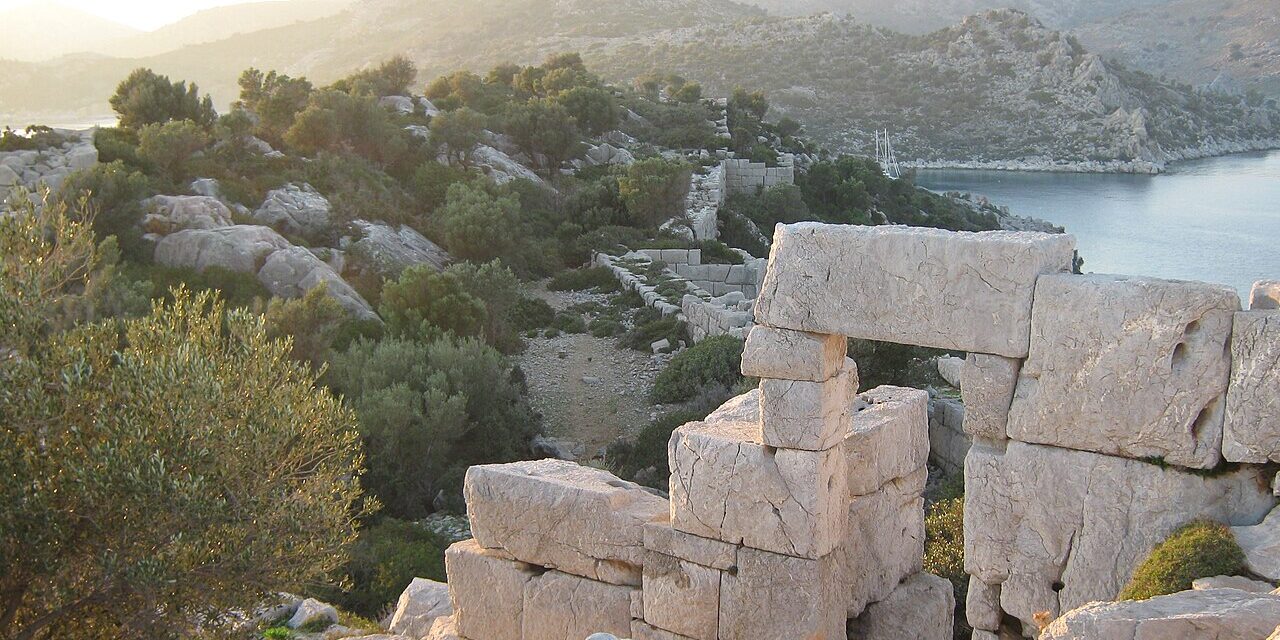
Visitors are often surprised by the sophistication of Bozukkale’s surviving architecture. The fortress walls serpent along the ridge and plunge sharply into the rocky ground. Bozukale was built in the 4th century BCE. The walls display a level of craftsmanship that suggests Bozukkale was more than a simple lookout point. Large polygonal blocks, fitted with almost impossible precision, form fortifications that extend nearly 120 meters. Nine rectangular towers once reinforced the enclosure, serving as watch positions and defensive platforms.
What makes the fortress especially compelling is its incomplete appearance. Scholars have long debated why its construction seems to have halted abruptly. Some believe it was never finished due to political or economic shifts in the region; others argue that earthquakes or conflict might have interrupted the work. Regardless, the ruins that remain are substantial, well-preserved, and evocative—a rugged skeleton that still clings defiantly to the hillside.
A Stage for Naval History
The bay’s shape and location made it an ideal staging ground for ancient naval operations. Historical sources describe Bozukkale as a strategic anchorage used by fleets during major conflicts of the Hellenistic era.
One of the most significant episodes occurred during the Peloponnesian War. The Athenian navy is said to have anchored in the bay while seeking allies in the region. Centuries later, Bozukkale served as a base for fleets preparing for the battle of Knidos. This was a decisive confrontation in 394 BCE between the Spartan and Persian navies. The calm waters and sheltered position allowed commanders to repair ships, resupply, and plan their strategies away from prying eyes.
Walking along the ridge today, it is easy to imagine the harbor filled with triremes and supply vessels, their sails lowered as soldiers and sailors moved between the rocky shore and the fortress above.
A Sanctuary for Sailors
Although its defensive role was paramount, Bozukkale also served as a practical maritime sanctuary centuries beyond its military heyday. The bay’s protected shape meant ships of all kinds—from Roman merchant vessels to Byzantine transports—could shelter here during storms or seasonal weather shifts.
Archaeologists have uncovered fragments of amphorae and pottery that suggest a long, continuous use of the harbor. Even in periods of decline, the peninsula’s isolation ensured that Bozukkale remained a quiet but dependable haven for mariners navigating the unpredictable waters of the Aegean and Mediterranean.
A Landscape of Solitude
Today, Bozukkale is best reached by boat or a demanding hike across the peninsula. This difficulty of access is part of its magic. Unlike more prominent ruins in Turkey, the site feels untouched, almost primordial. The silence is broken only by the wind coming off the sea, the call of goats wandering the hillside, or the distant hum of a yacht anchoring in the bay.
The views from the fortress walls are breathtaking. To the south, the island of Rhodes appears like a hazy silhouette on the horizon. To the east and west stretch the jagged cliffs and pine-covered slopes of the Carian coast. The combination of historical intrigue and natural beauty creates an atmosphere of deep time. There is a sense that the ancient and the present coexist seamlessly here.
For many visitors, the experience of Bozukkale is defined not just by the ruins themselves, but by the emotional resonance of the place: a blend of tranquility, awe, and a feeling of standing somewhere that was once crucial yet is now left entirely to nature.
Preservation Through Isolation
Because Bozukkale has escaped large-scale development, its ruins remain remarkably intact. There are no ticket booths, no crowds, and no fences to restrict exploration. This also places responsibility on visitors to tread lightly—respecting the fragile stones, avoiding climbing on delicate structures, and leaving the site as they found it.
Local initiatives and archaeological surveys have helped document the site, but Bozukkale still lies outside the typical tourist infrastructure. In many ways, its survival depends on the balance between increased interest and responsible stewardship.
Why Bozukkale Matters
While it may not hold the fame of Ephesus or the grandeur of Pergamon, Bozukkale offers an unfiltered connection to ancient history in a setting largely unchanged since classical times. Its significance lies not only in its military past, but in the insight it provides into how geography shaped ancient geopolitical strategy.
Bozukkale reminds us that the ancient world was not built solely on monumental temples or bustling cities. It was also sustained by remote outposts, fortified strongholds, and quiet harbors like this one. These places that played vital roles in the movement of ships, people, and ideas.
For travelers willing to venture off the usual paths, Bozukkale rewards with a profound sense of discovery. It stands as a testament to the enduring interplay between nature and human ambition. This crooked castle overlooking a perfect bay, still guards its secrets after thousands of years.